Interview with Al Ridenour (Bone & Sickle)
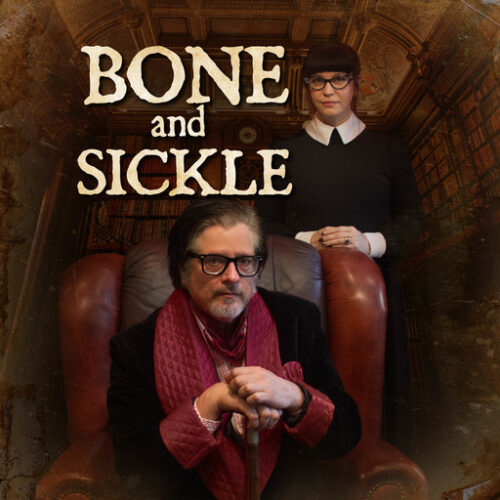
You may remember that on the first Sunday of the month, I didn’t post an interview. That’s because this month’s interview is with Al Ridenour, the host of Bone & Sickle. The anniversary of the podcast is April 30th, so that’s why you are getting it today (on April 30th). So lets all wish this great show a happy birthday and here’s to another 8 years!
Back when I first started really getting into podcasts, I discovered Bone & Sickle. It was a perfect match for me, with a great mix of strange humour, deep research, and a style that was really unlike anything I’d listened to before. It was also the first podcast that I messaged (I can’t remember the subject), but getting a reply back was a real thrill, and a first glimpse at how genuinely nice podcasters are.
There are a few podcasts that have transcended beyond the realm of “Just a podcast” to a level that is more of an institution. Bone And Sickle is one of those. Indeed, it won “Best Folklore Podcast” at my very first Podcastgeek Awards back in 2021. The show covers a great range of topics such as: Dark and Obscure Fairy Tales, Faustian Legends, Folklore, The Victorian Mummy craze, Shroud-Eaters and Sin-Eaters, Spook Shows of the ‘30s, German Folk Magic in America, Spanish Sorcery Schools, Russian Mystics and the Hollow Earth, Theosophy and Flying Saucers, Walpurgisnacht and more.
Hosting the show is the mysterious and intriguing Al Ridenour, and I am so happy to have blagged some of his time to answer these questions.

You started this podcast as an accompaniment to your book about Krampus. What was it about Krampus that inspired you so much to start this journey?
Writing a book is a very slow, isolating process. After going through that, I wanted to work on something that would allow me to share content more immediately and connect with people of similar interests, those interested in folklore, history and some of those darker themes that come up in considering the Krampus tradition.
Was Krampus your introduction to the world of folklore and weirdness, or had you always had an interest in dark folk customs?
I grew up in the late ‘60s and early ‘70s, on the tail end of the “monster kid” era, the trend fueled by the release of old horror films for TV broadcast and the appearance of late-night “horror hosts.” So, I was influenced by that, and all the marketing around it, the monster models and horror fan magazines. During my college years, The Wicker Man and reading James Frazer’s The Golden Bough, a 19 th -century classic of comparative mythology, got me interested in folklore. Majoring in German literature and culture, bolstered my interest in Grimm’s fairy tales and Gothic literature, and eventually, the Krampus. I lived in Germany for a year after graduation, which really locked it in.
Keeping with the European theme, is there anything creepier than the Schnabelpercht?
It’s definitely up there! I made a couple of those costumes for the Los Angeles Krampus troupe, btw. It’s surprising the attention the Schnabelperchten get worldwide considering they only appear in a single small town in Austria, in Rauris. The creepy figure that caught my eye more recently is on the cover of my latest book, A Season of Madness: Fools, Monsters, and Marvels of the Old-World Carnival. It’s a Sardinian Carnival figure wearing a donkey pelvis as a mask — a folk devil called Ainu Orriadore, from the town of Scano di Montiferro. Performers have their skin blacked with burnt cork, wear shaggy sheepskin coats, and drag chains associated with their folkloric role: capturing souls and announcing deaths.
Is there any particular story that has really got under your skin? When I was growing up, the story of “The Vampire Of Croglin Grange” terrified me for years.
That’s a good one! One of the subjects I explored in the podcast, is a type of revenant related to the vampire, reported especially in 17th and 18th century Germany and Poland. It was called the
Nachzehrer or the Schmatzende Toten (“Smacking Dead.”) The English term is “shroud-eater.” Even though they were never said to rise from their graves, there’s still something utterly terrifying about a ravenous corpse consuming its own shroud (or themselves) in the dark of its own coffin. The condition was said to be the result of an improper burial or suicide.
Back when you started, did you envision Bone And Sickle being such a magnum opus? Along with Hypnogoria and The Folklore Podcast (where I first heard you) Bone And Sickle is one of the big players in this niche.
Thanks! I guess I’m just stubborn. I am kind of surprised that we now have over 160 episodes. What makes it crazier are the monthly bonus episodes I started doing a few years in. There are around 70 of those now, available with a Patreon membership or for purchase/subscription via Apple Podcasts. They’re somewhat shorter (around 15-20 minutes) but with the same production level, that is, with background music and effects. The only mercy I’ve extended myself here is that I don’t write the scripts myself. They’re readings from old books related to the show content – folktales, historical curiosities and anomalies – usually from 19th -century books.
Apart from the in-depth research you pour into each subject, your show also has all the extra stuff going on in your weird world. From mummified cats to strange gardeners and bee circuses. What made you decide to add that? I’m not complaining, I love it. Folklore podcasts can get a bit stuffy, so your approach is a refreshing one!
I think a couple things inspired that. Because Bone and Sickle wasn’t conceived as a interview show like most podcasts, I was worried listeners would miss the conversational back-and-forth that lets them get to know the hosts as people – the thing that keeps an audience coming back. So my co-host, Sarah Chavez, and I give listeners something similar. They hear us, in our show personas (“Mr. Ridenour” and “Mrs. Karswell”), chatting about our fictional backstage world, before getting into the meat of each episode.
The imaginary manor house where all this takes place was inspired by my love old horror hosts, Chiller Theater type stuff, but less slapstick. More Edward Gorey’s world than Dr. Frankenstein and Igor. And old- time radio also shaped those opening segments – like the 1940s horror show Inner Sanctum with its vaguely sinister host “Raymond” bickering with “Mary the Lipton Tea Lady” (their sponsor) before each episode. More than anything, when it comes to absurdities like the Bee Circus, the radio artists Bob and Ray influenced me. Starting in the ‘50s and into the ‘80s, they created radio shows that subtly parodied conventional variety and news programming, playing it straight as reality came apart at the seams. All that old “theater of the mind” stuff I consumed as a nerdy kid came out in Bone and Sickle.
BONUS INSIDER TRIVIA: The audio open of each episode mentioning “the past unburied, the books unsealed” directly references the old radio series, The Sealed Book.
Over the years I’ve listened to the podcast, I’ve learned many things (not least how to pronounce “Goethe”) has there been a subject you’ve been especially proud of?
It feels like we always have to strike a balance between topics the audience has heard of and therefore may want to know more about and topics that are more obscure. I like doing the familiar topics because they come with the challenge of diving deeper, but uncovering stuff that’s lesser known is what’s most satisfying. I couldn’t pick a single show, but among them would be episodes about the medieval sorcery schools of Spain (#125), Mélusine the medieval serpent fairy (#138) or how the legendary underground Central Asian kingdoms of Agartha and Shambhala became an obsession of Russian mystics, artists, spies, and soldiers of fortune in the early 20th century (#131).
Do you have any more books in the pipeline? Can you talk about them?
Sure! In researching the Krampus book, I kept coming across celebrations involving performers in Krampus-like fur suits, bell-belts, and sometimes horns. I realized theses were Carnival traditions and put them aside for quite a few years, but finally dove into all this for my 2025 book, A Season of Madness: Fools, Monsters, and Marvels of the Old-World Carnival. Tentatively, those two books will be part of a 4- book series on folk celebrations, roughly corresponding to the four seasons. I’ve certainly already done plenty of research on Halloween, and a Spring-Summer book would include celebrations of May Day, Walpurgisnacht, and St. John’s Eve. We’ll have to see where that goes, but my publisher Feral House likes the idea.
Finally, why should people listen to Bone And Sickle? Give them the fear of missing out!
Listeners comment on the depth of research, which makes me happy. From the start, I’d committed to directly quoting the historical source texts. Those passages are read by Sarah Chavez, and are dramatized with music and sound effects. Actually, the entire show is backed by an elaborate soundscape. It’s pretty unusual for a podcast. At best, you normally have only some vaguely tinkling piano, stock music that’s just briefly faded up and out at transitions. But I look at each episode as a 45-minute television show that needs to be scored, but with more weight on the audio because there’s no video. And I’m very particular about creating music matched to the historical setting (which can become a research project of its own). Sometimes there are 20 or 30 layers of sound effects, down to the creak of a wooden bridge being crossed, the sound of a leather bag being handled, exhausted breathing after a character runs. The intent of it all is to project a movie into listeners’ minds, to send them off on an amusement park dark ride, to transport them to something faraway and long ago.
So there we have it. A priveliged peep into the dark and creepy world of Al Ridenour. This has been a real bucket list interview for me, and I’m grateful to him for taking the time to answer my questions. I hope you all listen to the show, but if you want to know more about Al and his work, then head over here